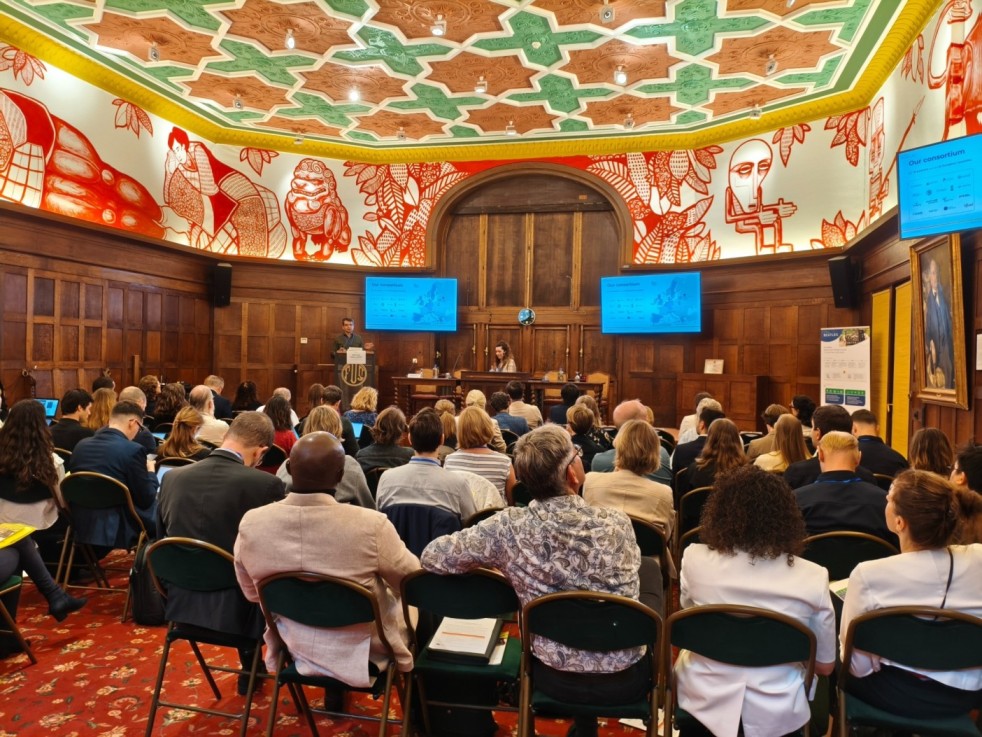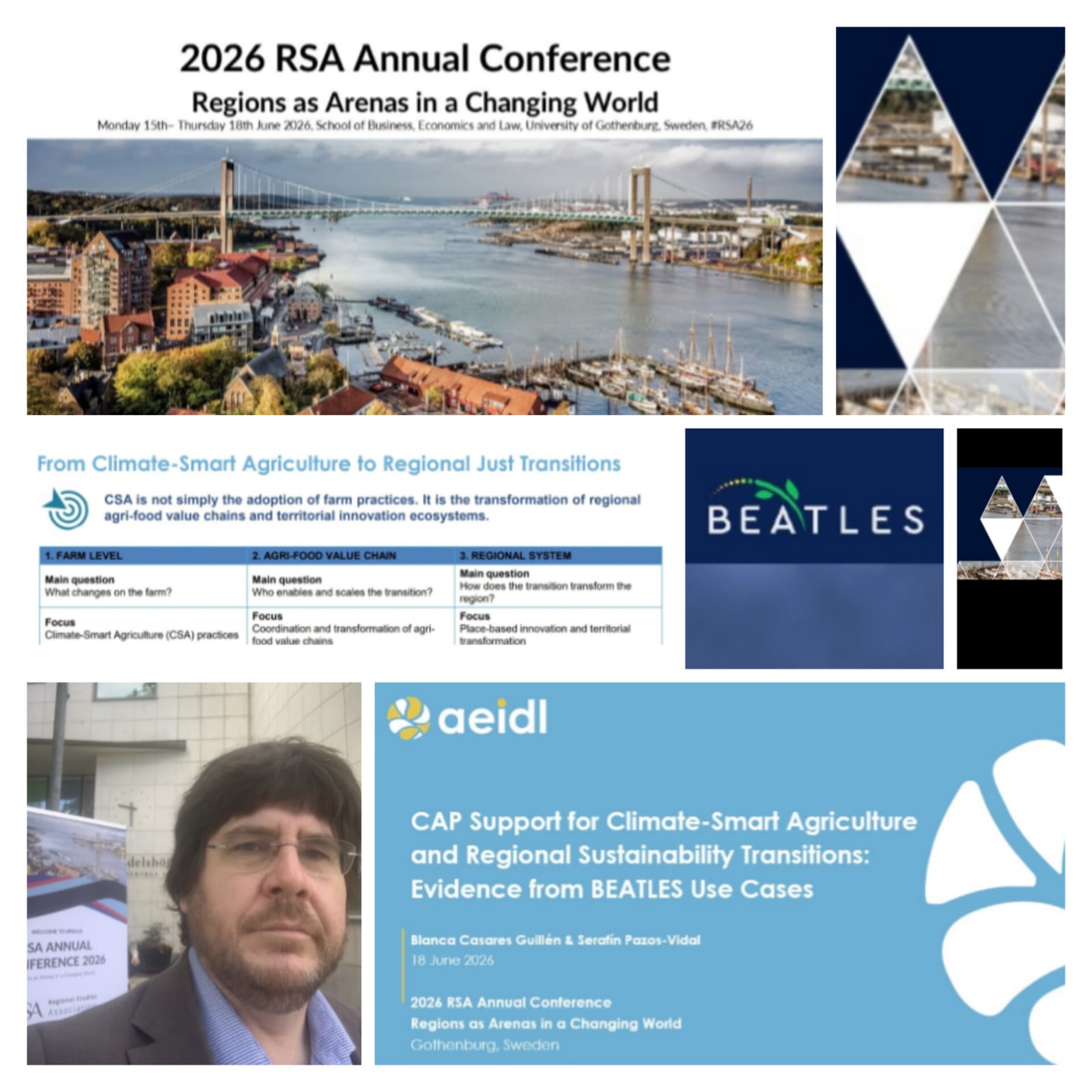
At the 2026 Regional Studies Associations Annual Conference in Gothenburg (Sweden), one of the largest academic gatherings in the world on territorial development, the results of the BEATLES Project were presented to a large academic audience.
Just one week after the large final policy event held in Brussels with EU policy makers the session “Sustainability, Innovation and Regional Development” brought together a diverse set of contributions examining how sustainability-oriented innovations emerge, diffuse and scale across territories. The discussion reflected a growing consensus in regional studies: transitions are not only technological, but deeply territorial, shaped by governance systems, institutional capacities and local contexts.
Within this debate, AEIDL presented the paper by Blanca Casares Guillén and Serafin Pazos‑Vidal with evidence from the Horizon Europe BEATLES project and emerging policy recommendations, focusing on the role of the Common Agricultural Policy (CAP) in supporting—or constraining—the uptake of Climate-Smart Agriculture (CSA) across European regions.
Their contribution provided a grounded policy perspective to a largely conceptual discussion, showing how the design and implementation of CAP Strategic Plans directly influence the geography of sustainability-oriented innovation. Drawing on comparative analysis across several Member States and extensive stakeholder engagement, they highlighted persistent barriers to the uptake of CSA practices, including limited financial incentives, administrative complexity, fragmented policy mixes and uneven advisory capacity. These constraints were shown to disproportionately affect small and medium-sized farms, raising important concerns about the social and territorial fairness of current transition pathways.
At the same time, the presentation pointed to concrete examples of more enabling approaches—such as better-aligned eco-schemes, coordinated policy calendars or support for local production systems—demonstrating that effective transitions depend on how policies are embedded within regional governance and innovation systems. A key takeaway was that upcoming policy frameworks, including National Regional Partnership Plans, could act as more mission-oriented instruments, provided they are better aligned with territorial realities and actor capacities.
This focus on governance and place-based policy design echoed several contributions across the session. For instance, work on transnational municipal networks highlighted how sustainability innovations increasingly spread through learning processes, institutional cooperation and knowledge spillovers beyond individual projects. Similarly, research on transformative innovation policy stressed the need to better identify and address regional “capacity gaps”, noting that successful transitions depend not only on technological or experimental capabilities, but also on institutional and adaptive capacities at local level.
From a different angle, the One Health regional approach illustrated the importance of integrating environmental, social and economic dimensions, with stakeholders emphasising the need for stronger coordination, resources and cross-sector collaboration to translate systemic visions into practice.
Taken together, the session highlighted a common message: while sustainability-oriented innovation is widely promoted at EU and national levels, its success ultimately depends on territorial embedding—the ability to connect policy frameworks, governance arrangements and local capacities in a coherent way.
In this context, the BEATLES contribution offered a timely and policy-relevant insight, demonstrating that CAP reform is not only an agricultural issue, but a key lever in shaping how sustainability transitions unfold across Europe’s diverse rural regions. The full policy recommendations will be shortly published in the BEATLES website and the tools to ensure transformation will be provided in a dedicated outlet www.climatesmartagri.eu. An introductory video is also available on YouTube, offering an early overview of the platform and its main functionalities.