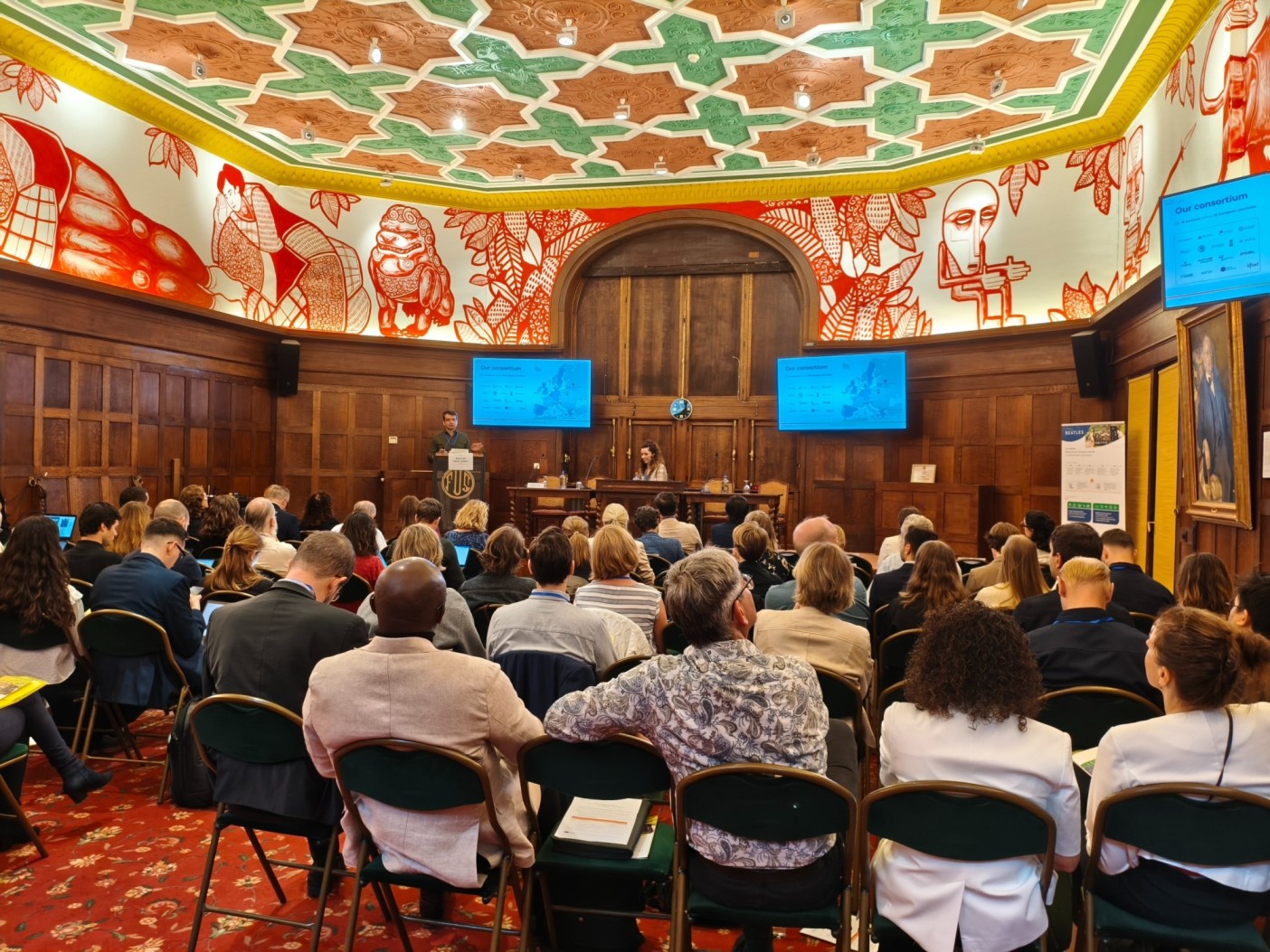
The BEATLES Final Conference took place on 2 June 2026 at the Fondation Universitaire in Brussels, Belgium. Organised by AEIDL, the event marked the conclusion of four years of research and collaboration, focusing on the role of behavioural insights in advancing CSA across Europe.
The conference brought together 100 participants from 15 countries, with strong representation from Belgium, reflecting the Brussels-based location of the event, and participation from across Europe, including Czechia, Germany, Denmark, Greece, Spain, France, Italy, Lithuania, the Netherlands, Portugal, Romania, Sweden, Slovenia, and non-EU countries.
The conference provided a unique opportunity for policymakers, researchers, farmers, advisors, civil society organisations and other stakeholders to come together, reflect on the project’s achievements, and discuss how behavioural approaches can contribute to more sustainable and resilient food systems in the years ahead.
The event opened with welcoming remarks and an overview of the BEATLES journey from Project Coordinator Marilena Gemtou and Spyros Fountas from the Agricultural University of Athens. They reflected on the project’s key achievements, lessons learned and the collaborative efforts that have shaped BEATLES over the past four years. Participants then heard a keynote address from Ricard Ramon i Sumoy of DG AGRI, who shared perspectives on how the Common Agricultural Policy (CAP) and future policy instruments can help accelerate the transition towards a more sustainable, resilient and innovative agricultural sector. This was followed by a presentation from Serafín Pazos-Vidal of AEIDL, who explored opportunities within the EU’s future 2028–2034 Multiannual Financial Framework to further support behavioural approaches in sustainable food systems.
One of the highlights of the conference was the presentation of the BEATLES policy recommendations and Climate-Smart Agriculture Toolkit by Blanca Casares, BEATLES Project Manager at AEIDL and leader of the project’s policy activities. The session showcased practical recommendations for integrating behavioural insights into future agricultural and food system policies, helping create more effective and farmer-centred approaches to sustainability.
The discussion continued with a high-level policy roundtable featuring María Fuentes Merino (DG AGRI), Emanuele Ciriolo (JRC), Stoyan Tchoukanov (EESC) and Krystyna Springer (IEEP). Together, they explored how the project’s recommendations can be translated into real-world action through current and future EU policy instruments. Topics included the integration of behavioural insights into the CAP, the potential of performance-based approaches and the importance of coordinated support for farmers adopting climate-smart practices.
The second part of the conference focused on the presentation of the project’s research outcomes and practical tools developed throughout BEATLES. Partners showcased key findings related to behavioural experiments, sustainability and behavioural assessment methodologies, innovative business models, advisors’ training tools, and co-creation processes developed through the BEATLES’ Use Cases and the EU Multi-Actor Working Group.
The event also included commentators from several sister and synergy projects working on sustainable food systems, including Erwin Wauters from ENFASYS, Raluca Barbu from VISIONARY, Anastasia Kannavou from PRUDENT, Gus Verhaeghe from B-TRUST, and Edelbis López Dávila from thERBN. Additional reflections were provided by Justine Auvrignon from the European Environmental Bureau, helping to connect BEATLES outcomes with wider European sustainability and innovation initiatives.
To support knowledge sharing and stakeholder engagement, five posters were displayed throughout the event, each dedicated to one of the BEATLES Use Cases. The posters highlighted the objectives, activities, and key outcomes of each Use Case and were displayed during the conference to facilitate knowledge exchange and stakeholder engagement. In addition, before the event, the project developed a Dossier of Results summarising the project’s main outcomes and policy-relevant findings for speakers and commentators. This document has been made available on the event website for external experts and stakeholders interested in the project’s main results.
The BEATLES Final Conference was not only a celebration of four years of collaborative work, but also a starting point for future discussions on how behavioural approaches can help create fairer, more resilient and sustainable agricultural systems across Europe.