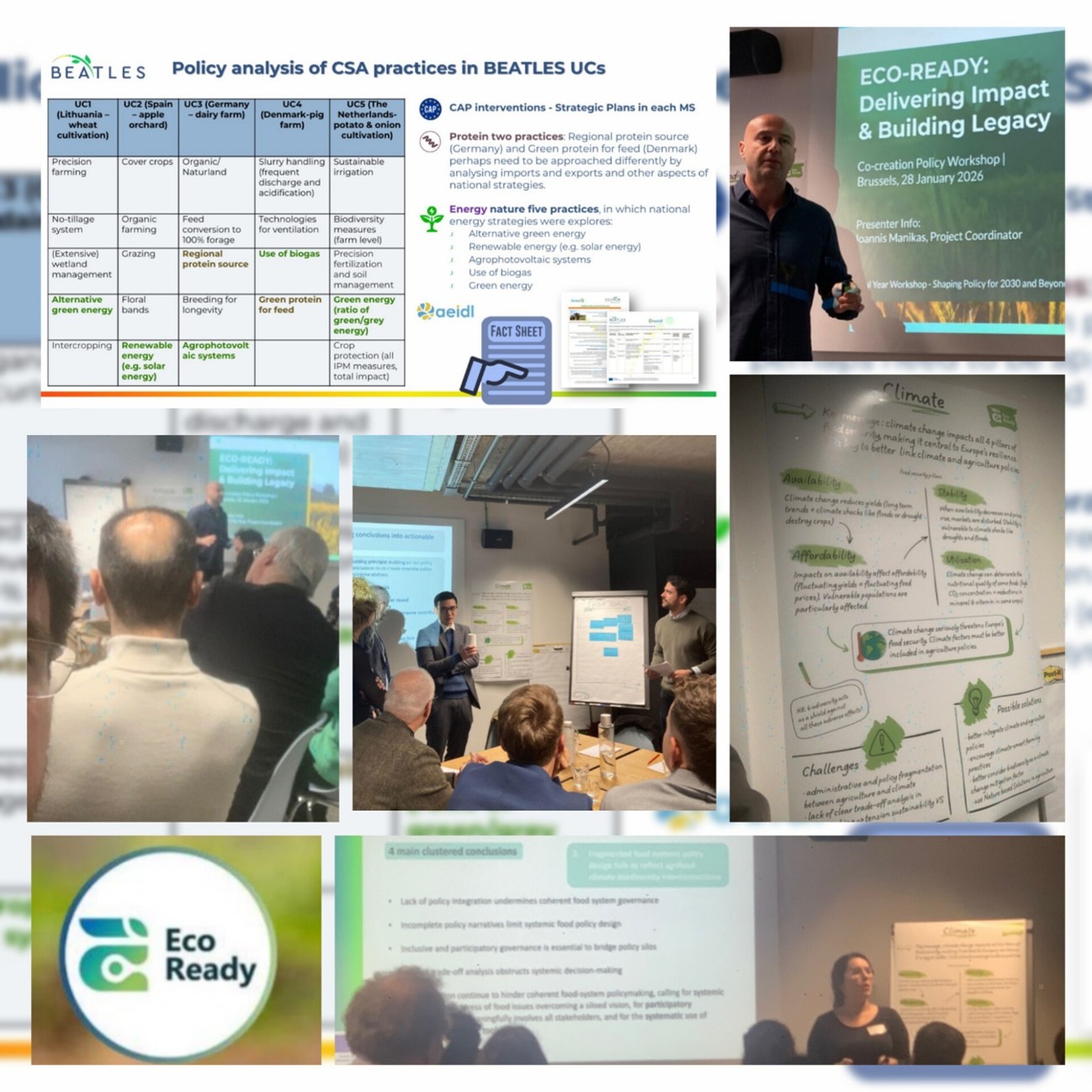
On 28 January 2026, the BEATLES project participated in the ECO-READY policy workshop “Delivering impact: building the ECO-READY legacy for food systems”, held in Brussels. The two-day event brought together ECO-READY partners, Living Lab representatives and selected Brussels-based experts to co-create policy recommendations and discuss the long-term sustainability of ECO-READY’s outcomes.
BEATLES was represented by AEIDL (European Association for Innovation in Local Development), the leader of BEATLES’ Work Package on Policy Recommendations. AEIDL contributed evidence and lessons learned from BEATLES’ research on behavioural drivers of change in agri-food systems, reinforcing the importance of behavioural insights for the design of effective food, climate, and biodiversity policies.
Behavioural insights for policy co-creation
During the policy co-creation workshops on Day 1, AEIDL’s Serafín Pazos-Vidal actively contributed to discussions on translating ECO-READY findings into actionable policy recommendations for sustainable and resilient food systems.
Drawing on BEATLES research, AEIDL highlighted how behavioural factors — including risk perception, trust, fairness, access to information, and policy coherence — strongly influence farmers’ and other actors’ willingness to adopt climate-smart and environmentally sustainable practices. These insights were particularly relevant to discussions on climate action, data and indicators, and sustainable consumption.
AEIDL also shared findings from BEATLES’ comparative analysis of 25 agricultural practices and 28 CAP interventions across five EU use cases, illustrating how differences in policy design, eligibility conditions, and financial support levels shape uptake on the ground. The discussions underlined that effective incentives must go beyond financial support, by addressing predictability, perceived fairness and consistency across policy domains.
Key messages from BEATLES
AEIDL emphasised several key lessons from BEATLES that closely align with ECO-READY’s objectives:
- Behaviour matters: The success of climate-smart and sustainable practices depends not only on economic incentives, but also on behavioural drivers and social contexts.
- Fairness enables transition: Policies perceived as fair, stable, and predictable are more likely to build trust and foster long-term engagement.
- Better indicators are needed: Monitoring systems should move beyond outputs to capture outcomes, impacts, resilience, and behavioural change.
- Policy coherence is essential: CAP instruments must be better aligned with other EU and national policies that influence farmers’ decisions.
Strengthening synergies between Horizon Europe projects
The participation of BEATLES alongside other Horizon Europe projects and civil society organisations highlighted the value of cross-project exchange in strengthening policy relevance and long-term impact. By connecting ECO-READY’s work on food system resilience and observatories with BEATLES’ evidence on behavioural insights and policy design, AEIDL helped reinforce synergies between EU-funded research initiatives.
Through its engagement in these co-creation processes, BEATLES continues to support the development of more effective, fair and behaviour-aware policies for the transition towards sustainable European agri-food systems.