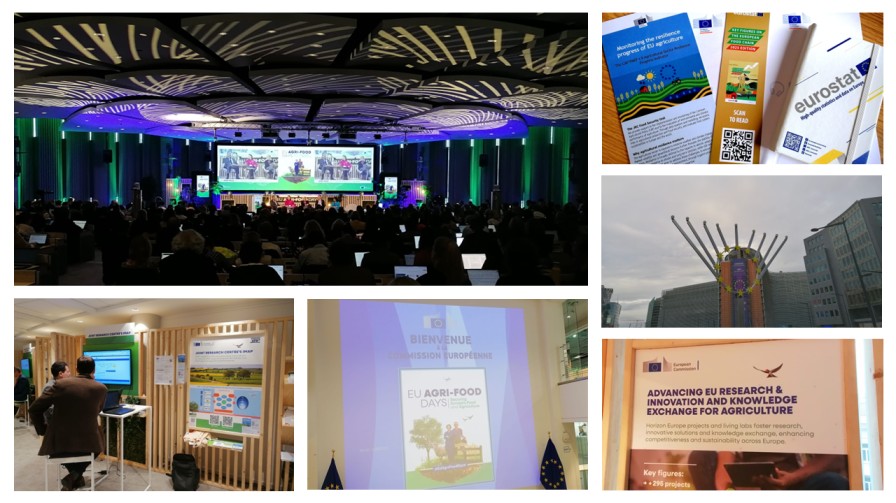
From 15 to 17 December, Brussels hosted the EU Agri-Food Days, the European Commission’s flagship annual event bringing together farmers, policymakers, researchers and stakeholders from across the agri-food sector.
The project partner, Blanca Casares Guillén, from AEIDL (European Association for Innovation in Local), who leads the policy Work Package within the BEATLES Horizon Europe, actively participated throughout the different sessions and debates of the conference.
The discussions at the Agri-Food Days provided a valuable space to reflect on the future of European agriculture and food systems, with a strong focus on the simplification of policy frameworks, strengthening fairness along value chains, and ensuring that farmers are effectively supported in the transition towards more sustainable and resilient production systems.
The debates strongly resonate with the objectives of the BEATLES project, particularly in relation to the Common Agricultural Policy (CAP) and the broader policy environment shaping farmers’ decisions. Throughout the discussions, simplification emerged as a necessary condition to improve accessibility, coherence and predictability for farmers. This aligns directly with BEATLES’ ambition to accelerate systemic and behavioural change across agri-food systems to enable effective uptake of Climate-Smart Agriculture (CSA) and smart farming technologies. By adopting a food systems approach, BEATLES views agri-food value chains as interconnected systems in which interactions between actors, policies and markets can unlock systemic innovation. Through the analysis of diverse crop and livestock systems across multiple European regions and the active engagement of value chain actors, the project identifies behavioural “lock-ins” and levers that influence decision-making. These behavioural insights are then translated into transformative pathways, combining fair business strategies and policy recommendations designed to support long-term, large-scale transitions towards sustainable, productive and climate-smart agri-food systems.
The European Commission has delivered 10 Omnibus packages and other simplification, as well as a range of additional measures aimed at reducing complexity and administrative burdens across multiple policy areas. Among these, three packages are particularly relevant for the BEATLES project. They include the simplification of the Common Agricultural Policy (CAP) to better support farmers and strengthen competitiveness; the simplification of environmental legislation, streamlining reporting obligations and procedures related to industrial emissions, the circular economy, environmental assessments and geospatial data; and the simplification of food and feed rules under the Vision for Agriculture and Food strategy, with the objective of reducing administrative burdens and costs for EU producers while maintaining very high standards of food safety and sustainability.
Reducing administrative complexity is increasingly seen as essential to ensure that public support reaches those who actively farm, facilitates fair trade practices and creates real incentives for sustainability rather than additional burdens.
A central message emerging from the discussions was the importance of placing the active farmer at the heart of future CAP interventions and of the upcoming National Regional Partnership Plans (NRPPs). Clearer recognition of active farming activity is key to reinforcing the legitimacy of public support and ensuring that funding is directed towards those who manage land, invest in production and deliver public goods.
In parallel, the continued relevance of Europe’s quality and standards in food production was strongly emphasised. High standards remain a core strength of European agriculture, supporting consumer trust, fair remuneration for farmers and more balanced value chains.
Panelists also highlighted a range of significant challenges that farmers are currently facing. Limited capacity to invest, increasing exposure to climate change and natural hazards, and growing economic uncertainty were repeatedly identified as major constraints. In this context, the role of insurance systems and collective safety nets was recognised as increasingly important to manage risks and protect farm incomes.
From the BEATLES project, we highlight that Climate Smart Agricultural (CSA) practices are a key lever for enhancing the sustainability, resilience and competitiveness of European agri-food systems, offering concrete pathways to address climate, environmental and economic challenges. However, their effective implementation often requires investments and enabling infrastructure, which are not always adequately supported by existing public funding mechanisms, underscoring the need for more coherent, targeted and long-term support frameworks.
This has led to a growing recognition of the gap between policy ambition and on-farm reality. The discussions pointed to the need for a shift in policy logic, moving away from subsidising production towards incentivising more sustainable practices and rewarding concrete outcomes. Such paradigm shift would provide clearer long-term signals for farmers, align economic incentives with environmental objectives and support more durable investment decisions.
In this context, the potential role of a European Competitiveness Fund was highlighted as particularly relevant. Such a fund could complement the CAP by supporting on-farm investments, accelerating the uptake of new technologies and fostering knowledge exchange between farmers. A broader bioeconomy perspective, strengthening value chains and linking sustainability efforts to market opportunities, was also seen as essential. Equally important is the dialogue with consumers, recognised as key drivers of demand and as partners in shaping more sustainable food systems.
Beyond advisory services, the discussions emphasised the need to engage a wider ecosystem of actors in the agricultural transition. While advisors play a crucial role in guiding farmers through change, other stakeholders such as investors also need to better understand the benefits and risk-mitigation potential of sustainable agricultural practices. Finally, it was stressed that, alongside the CAP, farmers require additional instruments that provide long-term stability, including secure land tenure, opportunities for land purchase and improved access to land.
These enabling conditions are fundamental to unlocking investment, supporting generational renewal and ensuring a fair and resilient future for European agriculture.
Author: Blanca Casares (AEIDL)